
A slow drain is rarely just a slow drain. It’s usually the first visible sign of a blockage that’s been building for weeks — grease, scale, roots, or debris narrowing the pipe from the inside until water barely gets through. Pour in a bottle of store-bought cleaner and you might buy yourself a few days. You won’t fix what’s actually causing it.
Declan & Sons Plumbing clears the real blockage, not just the part you can see — with motorized snaking for everyday clogs and hydro-jetting for the tougher ones roots and grease leave behind. Call (254) 489-8427 and get a real person, an honest look at what’s going on, and a flat price before we start.
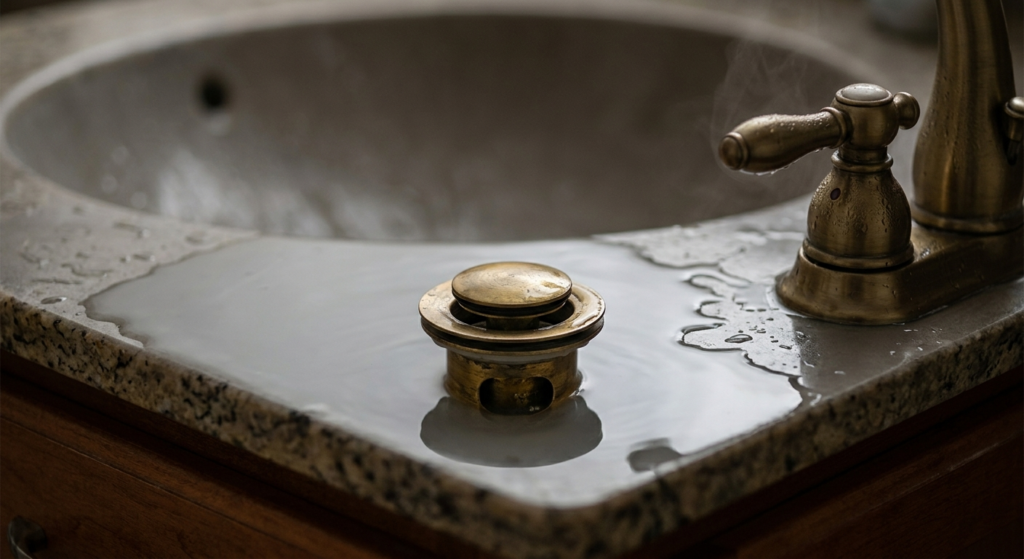
Some slow drains genuinely clear themselves out. Others are warning signs that you’re about to have a much bigger problem. Here’s how to tell which one you’re dealing with:
Call for professional cleaning if you notice:
These usually mean it’s time to stop DIY-ing it:
If more than one drain in the house is acting up at once, that’s not a fixture problem. That’s usually further down the line, and it’s worth a call before it turns into a backup.
A clog is a symptom. Before we clear anything, we want to know what’s actually causing it — because the fix depends on the answer.
Hard water scale narrowing the pipe. Waco’s water carries a high mineral content, and over time that mineral buildup coats the inside of pipes the same way it coats a water heater or a faucet aerator. A pipe that’s lost 20% of its interior diameter to scale clogs a lot faster than one that hasn’t.
Grease and soap buildup in kitchen and older bathroom lines. Grease doesn’t just wash away — it cools, hardens, and sticks to the pipe wall, and it grabs onto anything else that goes down the drain after it. This is the most common cause of a kitchen sink that “was fine yesterday.”
Corroded cast iron or galvanized piping. A lot of homes in and around Waco still run on original cast iron or galvanized drain lines. As these corrode from the inside, the interior surface roughens, and rough pipe grabs debris instead of letting it flow through — turning a pipe that should self-clear into one that clogs on a schedule.
Tree roots in older sewer lines. In Waco’s more established neighborhoods, mature trees have had decades to find their way into aging clay or cast iron sewer lines through small cracks or joints. Once roots get a foothold, they don’t stop. They thicken every year until the line is a fraction of its original diameter.
Foreign material that shouldn’t have gone down the drain. Wipes, hygiene products, food scraps, and even excess toilet paper are the most common culprits in main line backups, especially in homes with older, narrower pipes.
We diagnose which one you’re dealing with before we recommend a fix. Snaking a scale problem or jetting a root problem that needs a different repair entirely just gets you a callback in a few weeks.
Which drain, how long it’s been slow, whether other fixtures are affected — this tells us a lot before a plumber even arrives.
For a straightforward single-fixture clog, that might just mean locating it. For a recurring or main-line issue, we run a camera down the line to see exactly what we’re dealing with. Scale, roots, a collapsed section, or something else, instead of guessing.
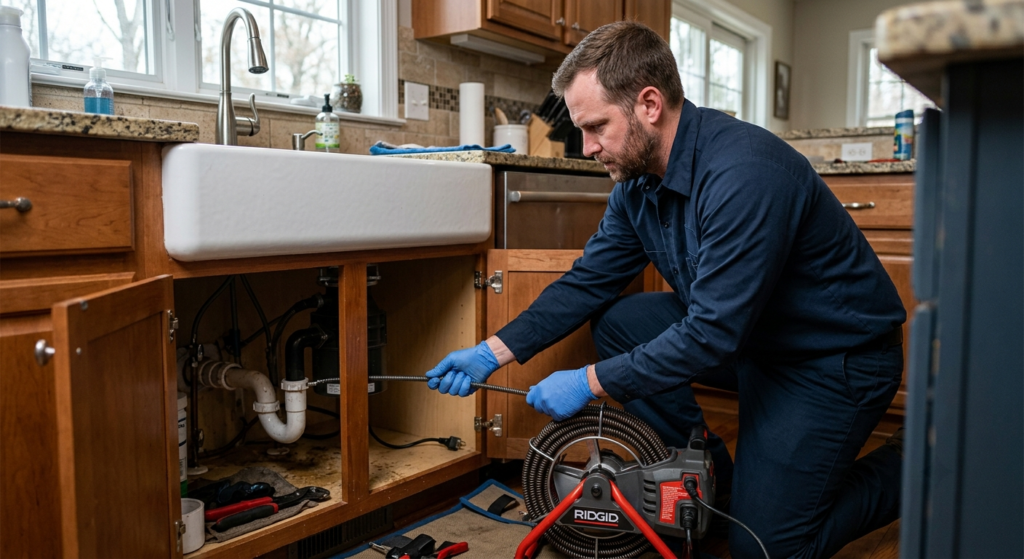
A motorized drain snake handles the majority of clogs, hair, soap scum, grease, and minor buildup. For heavier scale, grease-hardened lines, or root intrusion, we use hydro-jetting instead, since it scours the full interior wall of the pipe rather than just punching a hole through the clog. That’s the difference between a drain that stays clear and one that’s slow again in six weeks.
If the camera shows a cracked line, a bellied section, or root intrusion that a cleaning won’t permanently solve, we tell you before we recommend more cleanings that won’t fix the actual problem.
Central Texas plumbing has its own set of problems, and drains are no exception:
Hard water accelerates scale buildup inside every pipe in the house.
It’s the same mineral content that scales up a water heater, just working on your drain lines instead, and it’s constant, not seasonal.
Corroded pipe interiors snag debris instead of releasing it.
It’s not just that Waco has old cast iron and galvanized lines, it’s what corrosion does to how a drain actually clogs. A smooth pipe lets grease, hair, and debris slide through to the main line. A pipe with a corroded, pitted interior catches that same debris on the rough surface, which is why the same clog “recipe” causes a backup here that it wouldn’t in a home with newer PVC.
Mature tree root systems in established neighborhoods.
Decades-old trees near older sewer lines are a recurring cause of main line backups that a simple snake won’t permanently solve, which is exactly the kind of job hydro-jetting is built for.
We look at what’s actually causing the clog in a Waco home specifically, not just what’s causing clogs in general, which is why a drain we clear tends to stay clear.
5.0 ★ Rated Plumbing Services In Waco, Texas
Posted on Google
 Eugene Cochran
Trustindex verifies that the original source of the review is Google.
The customer service representative walked me through the annual service contract with a lot of patience. Despite challenging weather conditions, they managed to schedule my first plumbing service appointment. The whole team was impressive, particularly the technician who was assigned to my job. He bravely faced the inclement weather, when many would have retreated. Upon arriving, he wasted no time in diagnosing the problem with my kitchen sink drain. On two occasions in the past, a clog had resulted in drain water spilling into my dishwasher and onto my floor. His suggestion was to install a check valve to prevent any reverse flow. But he didn't stop there. He also added an extra check valve before the P-Trap, preventing any building water from backing up into the trap. His attention to detail was evident when he noticed missing levers from the sink shut-off valves and informed me. The technician didn't just focus on the immediate problem. He conducted a thorough inspection of the whole property as part of the first of the two annual checks. He even inspected the refrigerator ice-maker line at my request. Before leaving, he ran the dishwasher to ensure there were no leaks. The technician’s ability to explain everything clearly and repeat himself when necessary ensured I understood everything. His intelligence, knowledge, kindness, and patience made him a standout. You can be assured you're in excellent hands with this technician!Posted on Google weston saundersAlbert was polite, professional and explained he was doing. Would hire again. We discussed our problem and he was able resolve on same appointment.Posted on Google
 Becky Choiwonderful experience. Our repairman Cole is knowledgeable about his trade. He helped us out with our dilemma and was super Anyone would be lucky to have Cole come by for their plumbing problems.Posted on Google
 Derek26 NThey arrived out the same professional and clean. courteous and the whole process was super fast. I thought it was a little on the high side price wise but I needed it taken care of. Would endorse and use again if needed.Posted on Google
 Eva FlynnOur tech Gary was excellent. He made effort to get our up and running. Sadly for us, he discovered our motor was no longer operating. We just bought our building and expected the to not have much time after over 20 years.
It depends on what’s actually clogged and how it’s reached. A single fixture clog is a different job than a main line issue needing hydro-jetting. We diagnose the problem first and give you a flat price before any work starts, so you’re never guessing.
Yes, and here’s why: those chemicals can damage older cast iron or galvanized pipe, and if we do need to snake or camera the line afterward, that chemical is still sitting in the pipe. If you’ve already used one, just let us know when you call.
If only one fixture is slow, it’s usually local to that drain. If multiple drains are slow or gurgling at the same time, or water backs up somewhere unrelated when you run another fixture, that points to the main line, and it’s worth a call before it becomes a full backup.
A snake punches through a clog to get water moving again. Hydro-jetting uses high-pressure water to scour the entire interior wall of the pipe clean, not just clear a path through the blockage. We use snaking for everyday clogs and jetting when the line has heavy scale, grease buildup, or root intrusion that a snake won’t fully clear.
Yes, especially in older neighborhoods with mature trees. Roots find their way in through small cracks or pipe joints, and once inside, they keep growing. A camera inspection tells us if that’s what’s going on, and whether jetting or a repair is the right call.
There’s no universal schedule. It depends on your pipe age and household habits. If you’re getting a recurring slow drain even after clearing it, that’s usually a sign it’s time for a proper cleaning rather than another DIY attempt.
Yes. Call (254) 489-8427 and we’ll give you an honest estimate on how soon we can get there.
A drain that's slowing down now is telling you something. Get it looked at before it turns into standing water on the floor. Call (254) 489-8427 for a real person, an honest diagnosis, and a flat price before we start.